
How the AMA Doubled Its Membership Growth Rate

AMA Membership Growth Case Study

Client: American Medical Association (AMA)
Challenge: Flat membership, physician apathy, and a story no one was telling effectively
Outcome: Membership growth rate doubled; acquisition costs fell; retention rose; member satisfaction reached new highs

Amai Logo Digital Rgb

The Situation

When Todd Unger joined the American Medical Association as Chief Experience Officer, one of his first acts was to respond to a LinkedIn message from a physician who said he and his colleagues weren’t members — and didn’t feel the AMA represented them.

Most executives would have filed it away. Unger flew to meet him for lunch.

What he found in that airport hotel was a doctor who had written a book about what it felt like to be a physician in America today — spending two hours on administrative work for every hour of patient care, fighting insurance companies for basic approvals, watching patients leave the pharmacy unable to afford their prescriptions. The second chapter of that book was titled: Why the AMA Must Die.

Unger’s takeaway wasn’t defensiveness. It was clarity. “If I had him for 20 minutes,” he said, “I could turn that around. But I can’t fly all over the country and have lunch with everyone who doesn’t like the AMA. How do we scale this story?”

That question became the foundation of what Unger and Sequence Consulting would call the Digital Reboot.

What We Found

When Sequence began working with the AMA, the organization had done many things right. It had made changes, invested in modernization, and tried to keep up with a rapidly shifting profession. And yet membership was flat. The largest segment of physicians had no opinion about the AMA whatsoever — not hostile, not engaged, simply apathetic.

The diagnosis Sequence brought was precise: the AMA had a storytelling problem, not a product problem.

The organization was doing consequential work — speaking for physicians in Congress, confronting chronic disease epidemics, removing the administrative barriers between patients and doctors, driving the future of medicine. None of it was breaking through. Physicians didn’t know what the AMA was doing because the AMA had never built the infrastructure to tell them.

Three specific findings shaped what came next:

Physicians didn’t need more benefits. They needed a reason to believe. The instinct in most membership organizations is to add value through discounts, access, and tangible perks. What Sequence and the AMA team found was that these incentives could push someone over the edge — but they couldn’t create the underlying will to join. That required a clear, compelling answer to a simpler question: does the AMA represent me? Most physicians couldn’t answer yes, not because the AMA didn’t represent them, but because they’d never been told how.

Demographic segmentation wasn’t predictive. Behavioral segmentation was. The AMA had extensive research on physicians by age, specialty, and career stage. But these segments weren’t reliably associated with membership likelihood. Sequence led a mapping exercise that traced physician journeys from medical student through retirement — and the AMA team then built a data-driven behavioral segmentation from actual content interactions across email and web. Three segments emerged that were genuinely predictive: Practice Innovators (focused on running their practice and keeping up with technology), Activists (deeply engaged in advocacy), and Learners. Each needed different content, different messages, and different reasons to join.

The AMA’s publishing model was organized around internal priorities, not member needs. Content was produced by business units promoting their own work. The result was a fragmented publishing platform that served the organization’s internal structure rather than the interests of the physicians it was trying to reach. A tectonic shift was needed: from community newspaper to strategic publishing platform, with every piece of content evaluated against whether it served the member segments the AMA was trying to reach and retain.

The Approach

Working with Unger and the AMA membership and marketing team, Sequence helped design and execute the Digital Reboot — a comprehensive strategy to rebuild how the AMA recruited, engaged, and retained members across every digital touchpoint.

1. A new value proposition — built from listening, not assumption. The team went back to physicians, students, and residents and asked what they actually needed from the AMA. What emerged was a positioning built around a single idea: the physician’s powerful ally in patient care. Every word was chosen deliberately. Physicians had entered medicine as a calling. In an era when control over their practice was being stripped away — by insurers, by administrative burden, by technology — they needed someone unambiguously in their corner. That’s what the AMA could be, and that’s what the new positioning said.

2. Behavior-based segmentation driving personalized outreach. The new segmentation — Practice Innovators, Activists, Learners — replaced the old demographic approach and became the organizing logic for all membership communications. Instead of broadcasting the same message to all physicians, the AMA could now speak directly to what each segment cared about. An Activist received messages about what the AMA had saved them — “Did you know the AMA saved physicians $500 million a year by blocking that merger?” A Learner received content tied to clinical and educational resources. The response was consistent: I had no idea.

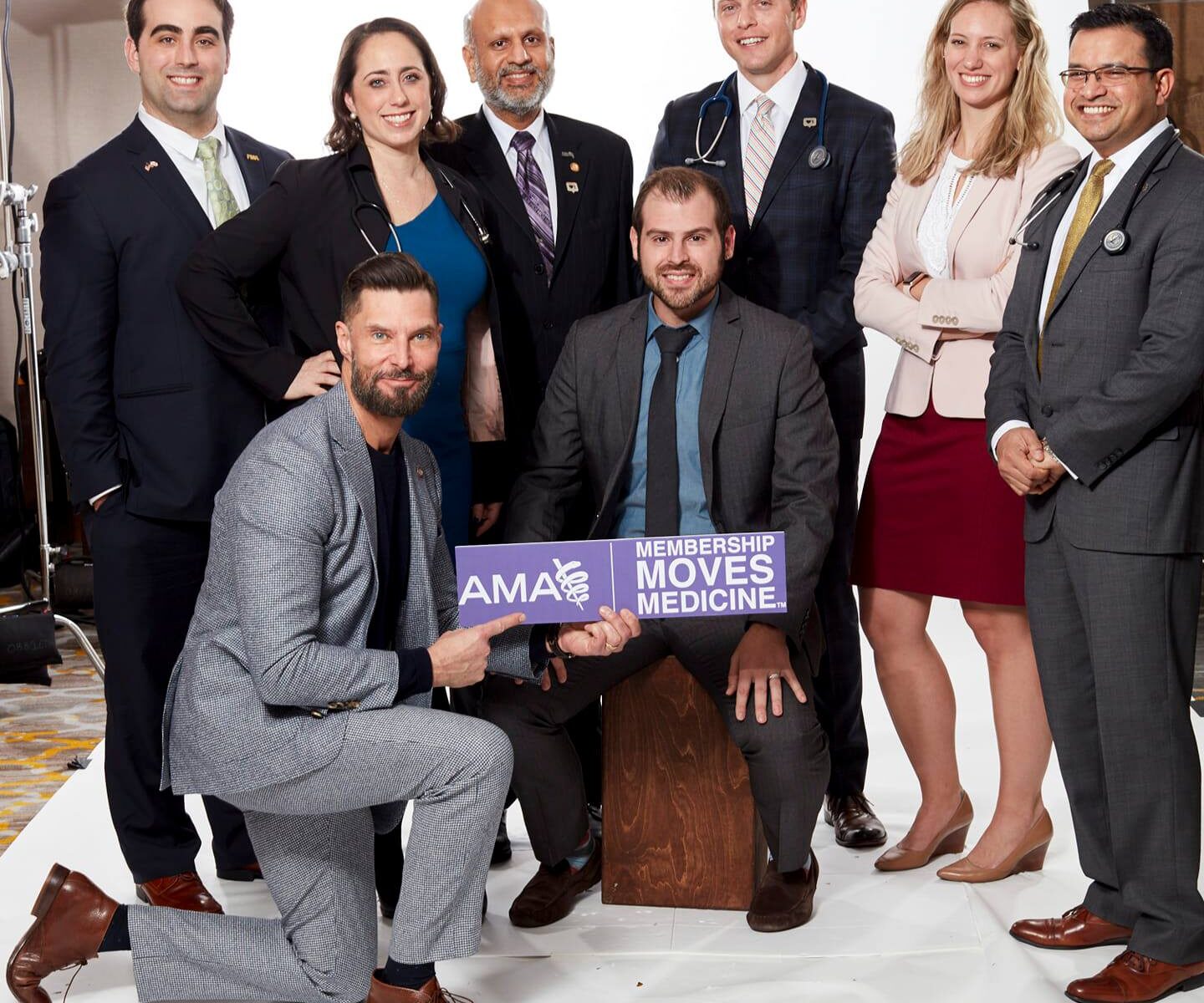
3. Membership Moves Medicine — a campaign built on proof points. The AMA launched a membership campaign called Membership Moves Medicine, built on a library of concrete, translatable proof points drawn from across the organization. The hard work wasn’t creative — it was canvassing every corner of the AMA, listening to what was actually being achieved, and translating organizational wins into language that a physician would recognize as relevant to their daily life. The campaign closed the gap between what the AMA was doing and what physicians knew it was doing.

4. Making physicians feel powerful — literally. One of the most unexpected elements of the campaign came from a photographer who normally shoots celebrities. The AMA began photographing its own members — physicians, students, residents — in the same style. When one member picked up her photo, she said: I feel really powerful. That moment crystallized something important. The AMA’s value proposition was about being a powerful ally. If the organization could make physicians feel powerful through its marketing — in an era when control was being taken from them — that was the brand strategy made real. Forty-foot banners with member faces hung from the ceilings at the AMA’s annual meeting. For many staff, it was the first time they’d seen a member’s face in the building.

5. Rebuilding the affinity program around real physician needs. The existing affinity program was a semi-random basket of discounts — including a popular Mercedes-Benz discount that drove joins but not loyalty. Members would join for the discount and leave. Sequence helped the AMA rethink the program from scratch: not what could generate revenue or partner fees, but what would meaningfully address the real problems physicians faced. The result included partnerships targeting physician burnout (Headspace meditation, offered free for two years) and medical student debt (Laurel Road financial services). Benefits that aligned with the AMA’s mission and built the kind of value that drove renewal.

The Result

The AMA doubled its membership growth rate.

Acquisition costs fell. Retention improved. Member satisfaction reached new highs. And critically, the Digital Reboot didn’t just produce numbers — it produced a repeatable system. The behavior-based segmentation, the proof-point publishing model, the Membership Moves Medicine campaign infrastructure — these weren’t one-time interventions. They were capabilities the AMA now owned and operated.

The results have been independently corroborated by multiple external sources. ASAE’s Associations Now reported that “AMA experienced a 35 percent growth from 2011 to 2020. And, during the first year of the pandemic, membership was the greatest it’s been since 1949.” At the AMA’s 2024 House of Delegates meeting — documented in a report published by PubMed — the CEO stated that membership had “climbed to levels not seen for decades” and that the AMA had achieved “outstanding financial stability.” These are not claims made by Sequence. They are documented by independent editorial and institutional sources.

Todd Unger, Chief Experience Officer, American Medical Association

“We doubled our rate of growth much faster than expected. Our acquisition costs are lower. Our members are happier and more engaged. Retention is up.” — Todd Unger, Chief Experience Officer / SVP Physician Engagement, American Medical Association

“It’s been a dramatic impact. Transformative. They’ve been critical in achieving what we have in two years. We could have never done it without Sequence.” — Todd Unger, American Medical Association

What This Means for Your Association

The AMA’s challenge before the Digital Reboot is one of the most common patterns Sequence encounters: an organization doing genuinely valuable work that its members don’t know about, communicate in language its members don’t connect with, and structured around the organization’s internal logic rather than the member’s actual experience.

The instinct, when membership is flat, is to add benefits, run promotions, or invest in acquisition campaigns. What the AMA’s story shows is that none of that works until the underlying story is right. Incentives can push someone over the edge. They can’t create the will to join.

Three questions worth asking about your own association:

If a physician — or engineer, or attorney, or accountant — asked you why they should join, could you answer in 30 seconds in a way that made them feel represented and understood? Or would the answer be a list of benefits they could probably find cheaper elsewhere?

Does your content serve your members’ interests, or your organization’s internal structure? The two are often not the same.

Do your members know what you’ve done for them lately — specifically, concretely, in terms they recognize as relevant to their daily work?

For the AMA, the answers to those questions in 2015 were uncomfortable. The work of making them comfortable again is what the Digital Reboot was. And the growth that followed wasn’t luck — it was the predictable result of an organization that finally learned to tell its own story.

This is one of two case studies from Sequence Consulting’s work with the American Medical Association. Read the companion piece on how the AMA captured the employed physician market through its Health System Engagement program — and reached record total membership.

About Sequence Consulting Sequence Consulting works exclusively with professional and trade associations to grow membership, strengthen revenue, and clarify strategy. Founded in 2001 by Chris Vaughan, PhD and Lisa Vaughan, Sequence brings the rigor of Big Strategy consulting to mission-driven organizations. Trusted by 12 of the top 20 U.S. associations.


[Schedule a conversation about your membership growth →]

How the AMA Reached Record Membership by Reimagining Who Its Customer Was

AMA health system membership growth case study
Client: American Medical Association (AMA)
Challenge: Half of all U.S. physicians were now employed by health systems — and the AMA’s individual membership model was structurally unable to reach them
Outcome: Group membership grew 158% in five years; AMA reached 302,000 dues-paying members — the highest total in its history
Amai Logo Digital Rgb

The Situation

For most of its 175-year history, the American Medical Association built its membership around a single, stable assumption: physicians are independent professionals who make their own membership decisions. The model worked. For generations, the AMA enrolled physicians one at a time, built loyalty through individual engagement, and grew into the largest physician organization in the United States.

Then the physician market changed — and the model didn’t.

By the time Sequence Consulting began working with the AMA on its group membership strategy, more than half of all practicing physicians in the United States were employed by hospitals and health systems rather than practicing independently. Eighty percent of residents completing training were entering employed positions. The population of independent physicians — the traditional target of individual AMA membership — was declining every year, from 38.5% of practicing physicians in 2021 to 33.6% by 2025, with projections showing continued decline toward 28% by 2030.

The consequence was structural, not incidental. AMA penetration among employed physicians was just over 1%. The organization had built a sophisticated, well-resourced individual membership program — and it was aimed at a shrinking market while the majority of physicians sat largely out of reach.

The AMA wasn’t in crisis. Total membership was holding. But the trajectory was unmistakable, and the underlying market reality was getting harder to ignore: the individual membership model, however well executed, could not reach employed physicians at scale. The buyer had changed. The product hadn’t.

What Sequence Found

Sequence’s work began with a rigorous diagnosis of the physician market and the economics of the existing membership model — asking not just what was happening to membership, but why, and what it would take to change it.

The findings were precise and, in some cases, uncomfortable.

The individual membership model was structurally misaligned with how employed physicians made decisions. An employed physician doesn’t make the same kind of membership decision as a private practitioner. Their time is allocated by their employer. Their professional development resources are often managed or influenced institutionally. Asking an employed physician to opt in to AMA membership individually — paying out of pocket, justifying the time — was asking them to behave like an independent professional when they weren’t one. The barrier wasn’t the AMA’s value. It was the model.

The AMA had already tried to solve this with discounts — and it hadn’t worked. Before 2018, the AMA offered a group program structured primarily as a bulk discount on individual membership. Larger health systems received larger discounts — up to nearly 50% off — and participation generally required 75% physician uptake. Despite the apparent generosity of the offer, there were essentially no takers.

The reason was instructive: framed as discounted individual memberships, the decision fell to physicians, who didn’t see enough individual value to opt in at scale. Meanwhile, even the discounted price represented a meaningful system-level expense with no clear system-level return. The problem wasn’t the price. It was that health systems were being asked to buy something designed for a different buyer.

The real opportunity was to reframe the buyer entirely. Sequence’s analysis identified a different question: not “how do we get more employed physicians to join individually?” but “what would make health systems want to provide AMA membership to their physicians?” Health systems had strong organizational reasons to invest in physician engagement — burnout, retention, workforce stability, and credibility were all significant institutional priorities. An AMA relationship that addressed those priorities was potentially very valuable to a health system CEO or CMO. The AMA had never approached health systems as customers.

The shift in physician practice was not temporary. Sequence’s research made clear that the trend toward employment was structural, not cyclical. Independent physicians had declined every year for more than a decade. The pool of physicians making individual membership decisions was shrinking, older, and less responsive than it had ever been. Any strategy that depended primarily on individual physician acquisition was working against the grain of the market. Future growth required reaching physicians through the institutions where they worked.

The Approach

Sequence designed the health system membership model, built the case for it internally at the AMA, and drove it through board approval — a process that required convincing a 175-year-old physician membership organization to fundamentally change who its primary customer was.

That internal challenge is worth acknowledging. Proposing that the AMA launch a B2B institutional membership category — shifting from individual physician as buyer to health system as buyer — required making the case to leadership, staff, and a volunteer board that the existing model had a structural blind spot. Sequence researched, designed, and presented the analytical case that moved the organization from skepticism to commitment.

The model that emerged was built around three core shifts:

1. Health system as buyer, physician as member. Rather than asking employed physicians to make individual membership decisions, the new model positioned health systems as the purchasing entity. A single institutional decision could enroll hundreds or thousands of employed physicians. This removed the individual friction that had kept employed physician membership at 1% and aligned with how health systems already thought about physician benefits and professional development investment.

2. A value proposition built around system-level priorities, not individual benefits. The redesigned offer moved decisively away from discounted individual membership. Instead, it bundled AMA membership with assets tied directly to what health system leaders cared about: physician well-being programs and burnout assessment tools, access to AMA’s advocacy team, organizational recognition through AMA channels and the Joy in Medicine program, workforce support resources, and the institutional credibility of AMA partnership.

Health systems were no longer being asked to subsidize individual dues. They were being offered a partnership built around the outcomes their organizations were already trying to achieve. The conversation shifted from “how much of a discount?” to “what does this do for our physicians and our organization?” — and it resonated.

3. A tiered flat-rate pricing model that supported institutional decision-making. The pricing structure was designed for an organizational buyer, not an individual one. Tiered flat-rate pricing based on system size made the cost predictable, budget-friendly, and easy to approve internally. It removed the per-physician math that had made the earlier discount model feel expensive at scale and positioned the AMA as a strategic partner rather than a vendor negotiating headcount.

The Permanente Federation joined as the program’s charter member in 2018. Its participation — a large, historically independent health system choosing to engage with the AMA in a fundamentally new way — was the proof point that made the model real for the market.

The Result

Group membership grew 158% in five years — from approximately 26,000 physician members in 2021 to nearly 67,000 by 2025.

The AMA reached 302,000 dues-paying members in 2025 — the highest total membership in the organization’s history.

That record didn’t happen because individual membership rebounded. It happened because the health system model opened access to a population of physicians the individual model couldn’t reach. While individual physician membership declined modestly over the same period — a reflection of the structural market shifts Sequence had identified — group membership more than compensated, driving the overall total to historic highs.

The model also changed the economics of membership in important ways. Group membership renews at the health system level rather than the individual physician level, which means revenue is retained even as individual physicians come and go within a system — a fundamentally more stable retention dynamic than individual opt-in renewal. Health system members view AMA membership as a valuable professional benefit of their employment. Health systems leverage that as a physician recruitment and retention tool.

In the words of health system leaders who joined the program: “We came in through Joy in Medicine, but it quickly became more than that — it helped us organize everything we were trying to do around physician well-being.” And: “It gives us credibility internally. It helps us align leadership and show that what we’re doing is grounded in something bigger.”

What This Means for Your Association

The AMA’s health system story is not a healthcare story. It’s a structural story — and the structure it describes is playing out across every profession that has seen significant consolidation, employment, or institutionalization over the last two decades.

The pattern Sequence identified at the AMA shows up in law, accounting, engineering, architecture, pharmacy, and dozens of other fields: a profession that was once largely independent is increasingly practiced within large organizations. The individuals associations want to reach are employed. They make fewer independent professional decisions. And the membership models built for a world of independent practitioners are gradually losing their reach.

The AMA was reaching 1% of employed physicians not because those physicians didn’t value what the AMA offered. It was because the model required them to behave like independent practitioners. When Sequence reframed the question — from “how do we recruit employed physicians?” to “how do we become valuable to the organizations that employ them?” — the entire growth equation changed.

Three questions worth asking about your own association:

Has the professional or organizational structure of your potential membership base shifted significantly in the last decade? Consolidation, employment, and institutional scale mean that in many professions, the people associations want to reach are making fewer independent decisions. If your membership model is built for independent decision-makers and your market has moved toward employed or institutionally affiliated professionals, you may be facing a version of the AMA’s challenge.

Are there institutional buyers — employers, firms, systems, agencies — who have organizational reasons to want their people engaged with your association? Physician well-being, workforce retention, professional development, and institutional credibility are the reasons health systems engaged with the AMA. Most large employers in most professional fields have analogous priorities. The question is whether your association has built a value proposition that speaks to those priorities at the organizational level.

Is your membership product designed for how your potential members actually make decisions today — or for how they made decisions when your model was built? This is the hardest question, because it requires acknowledging that a model that worked well for a long time may no longer fit the market it was designed for. The AMA’s individual membership model wasn’t broken. The market around it had changed.

The lesson of the AMA’s health system model is not that individual membership doesn’t matter — it does, and the AMA continues to invest in it. The lesson is that when the market shifts structurally, the associations that grow are the ones willing to ask whether their model still fits the world their members actually live in.

This is one of two case studies from Sequence Consulting’s work with the American Medical Association. Read the companion piece on the Digital Reboot — how the AMA transformed its individual membership program, tripled its growth rate, and rebuilt the case for individual physician membership.

About Sequence Consulting Sequence Consulting works exclusively with professional and trade associations to grow membership, strengthen revenue, and clarify strategy. Founded in 2001 by Chris Vaughan, PhD and Lisa Vaughan, Sequence brings the rigor of Big Strategy consulting to mission-driven organizations. Trusted by 12 of the top 20 U.S. associations.

[Schedule a conversation about your revenue strategy →]

How SAE International Created a New Business Model — and Grew Non-Dues Revenue 10X

SAE International non-dues revenue growth case study
Client: SAE International
Challenge: A century-old engineering association with a revenue model built on dues and events, facing rapid industry disruption it had no commercial vehicle to address
Outcome: Sequence conceived and designed the Industry Technology Consortia (ITC); ITC revenue grew 10x

The Situation

SAE International has been the backbone of engineering standards for over a century. In automotive, aerospace, and commercial vehicle industries, SAE’s technical standards, publications, and events are foundational — the kind of institution engineers take for granted because it has always been there.

But by the time SAE engaged Sequence Consulting, the industries it served were undergoing some of the most rapid and consequential technological change in their histories. Electrification, autonomy, connectivity, cybersecurity, and advanced manufacturing were reshaping automotive. New entrants — technology companies, startups, software-first organizations — were entering spaces that had previously been the exclusive domain of traditional OEMs and suppliers. In aerospace, digital systems and new platform architectures were creating similar disruption.

Rapid technological change was creating what Sequence’s analysis described as “whitespaces” — areas where the industry had not yet aligned on critical issues. Quality. Safety. Standards. Cybersecurity. Counterfeit avoidance. These were not competitive battlegrounds where companies fought for advantage. They were pre-competitive challenges where misalignment hurt everyone — and where reaching shared solutions required bringing competitors into the same room.

The problem was that almost no trusted space for that kind of collaboration existed.

Trade associations focused on policy. Consultants worked for proprietary advantage. Academia pursued basic research. None of them could do what the moment required: convene competitors in a closed, trusted environment to work through shared technical challenges before the competitive phase began.

SAE could. It had the credibility, the neutrality, the industry relationships, and the technical expertise. What it didn’t have was a commercial vehicle designed to do it.

That’s what Sequence was brought in to create.

What We Found

Sequence began with a rigorous analysis of SAE’s competitive position, the market opportunity created by industry disruption, and the organizational assets SAE had that no one else could replicate.

Three findings drove the strategy:

SAE’s most valuable asset was not its content — it was its neutrality. Most associations think of their value in terms of what they produce: standards, publications, education, events. Sequence’s analysis pointed to something different. SAE’s deepest competitive advantage was its unique ability to convene competitors around shared technical challenges without any party at the table having a commercial stake in the outcome. In industries racing to solve shared problems — cybersecurity vulnerabilities, counterfeit components, autonomous vehicle safety standards — that neutrality was extraordinarily valuable. Companies that would never collaborate directly would work together under SAE’s roof. This asset was not being monetized.

Technology disruption was creating a structural market gap that SAE was uniquely positioned to fill. The whitespaces created by rapid technological change — the areas where industries needed pre-competitive consensus and had nowhere to get it — were growing faster than traditional SAE programming could address. The opportunity was not incremental. It required a fundamentally different kind of organization: one focused on industry-level problems rather than individual engineers, structured for closed collaboration rather than open publication, and built to operate as a B2B enterprise rather than an individual membership model.

SAE’s existing model had structural limits that wouldn’t allow it to serve this opportunity. As a 501(c)(3), SAE faced constraints on the kinds of commercial and competitive-intelligence activities that industry consortia required. Serving for-profit players in the industry — as a full commercial partner, not just a standards body — required a different legal and organizational structure. The opportunity required a new entity, not an extension of the existing one.

The central insight Sequence brought: SAE had a genuine right to win in pre-competitive industry collaboration — an advantage no trade association, consultant, or academic institution could replicate. But capturing that opportunity required building a new kind of organization from scratch, purpose-built for the B2B market the disruption had created.

The Approach

Sequence conceived the Industry Technology Consortia — ITC — and designed its strategy, positioning, organizational model, and go-to-market approach from the ground up.

ITC was structured as an affiliate of SAE International: legally and operationally distinct from the parent organization, able to serve for-profit players in the industry in ways a 501(c)(3) could not, but leveraging the full weight of SAE’s brand, credibility, intellectual property, industry leadership, and global reach.

The Way to Play Sequence designed for ITC was precise: create advantage for the industry where technology is creating new spaces, by convening and curating industry resources — people, IP, tools, capital — and leveraging SAE’s credibility and leadership in these spaces to produce pre-competitive responses.

This wasn’t a vague mission statement. It was a specific competitive positioning built around three things ITC could offer that no other organization could:

Trusted neutral ground. ITC provided closed, safe spaces where competitors, technical experts, and government representatives could collaborate and confer on issues of mutual advantage — without fear that participation would benefit a competitor or compromise proprietary information. The legal structure, governance design, and operational protocols were built specifically to make that trust possible.

The ability to convene the right resources. Pre-competitive collaboration fails not because companies don’t want to participate, but because someone has to organize it, manage it, fund it, and keep it on track. ITC provided the infrastructure — legal structure, financial systems, administrative and operational support, technical expertise — that turned good intentions into functioning consortia.

SAE’s enterprise assets as a competitive moat. No startup or new entrant could replicate what ITC launched with: SAE’s century of industry credibility, its intellectual property portfolio, its established relationships across automotive, aerospace, and commercial vehicle industries, its global reach, and its volunteer base of senior technical leaders. These were not things ITC had to build. They were the foundation it was built on.

The lines of business ITC launched included cooperative research programs, cybersecurity initiatives, counterfeit avoidance programs, avionics collaboration, and auditor authentication — each addressing a specific whitespace where industry needed pre-competitive consensus and had no existing home for it. The model was explicitly designed to expand: the core markets were automotive, aerospace, and commercial, with an explicit eye toward other industries where SAE’s capabilities could transfer.

The Result

ITC revenue grew 10x.

That number reflects not just financial performance but organizational transformation. Sequence didn’t help SAE grow an existing revenue line. It designed a new business — a new legal entity, a new organizational model, a new go-to-market strategy, a new value proposition — that opened a market SAE had never served and created a revenue stream that hadn’t existed before.

The growth also validated the strategic thesis. The whitespaces Sequence identified were real. The demand for trusted pre-competitive collaboration was real. And SAE’s right to win in that space — built on credibility and neutrality that no competitor could replicate — was real.

“Working with Sequence, our organization grew tenfold, we entered entirely new industries, and we expanded our industry consortia fivefold — all within three years.”
— David Schutt, PhD, CEO, SAE International

Andrew Smart Sae International

“Sequence Consulting is that one-in-a-million consulting group.”
— Andrew Smart, Chief Membership and Marketing Officer, SAE International

What This Means for Your Association

The SAE story is one of the most important questions facing mature associations today: when your existing model has structural limits, where does growth come from?

The instinct in most associations is to optimize what already exists — grow membership, improve events, cut costs, add programs. Sequence consistently finds that when an association has reached a structural ceiling, optimization isn’t the answer. The answer is a genuinely different way to create and capture value.

For SAE, that meant recognizing something most associations miss: the most powerful asset they had wasn’t what they produced. It was what they uniquely could do. SAE could convene competitors in trusted, closed spaces. No one else could. The question Sequence brought was whether SAE had a commercial model built around that capability — and the answer was no. Building ITC was the answer.

The transferable principle is this: almost every mature association has assets it undervalues because those assets aren’t generating revenue today. Standards bodies have neutrality and technical credibility. Professional societies have access to elite practitioners. Trade associations have relationships across an entire industry. The question isn’t what you’re already monetizing. It’s what you uniquely can do that no one else in your industry can — and whether you’ve built a business model designed to capture value from it.

A few questions worth asking about your own association:

What does your organization uniquely make possible that no trade association, consultant, or academic institution can replicate? This is your right to win — and it may be underleveraged.

Are there market needs in your industry — problems your members’ industries face that require neutral convening, trusted collaboration, or shared infrastructure — that no one is currently serving well? These are your whitespaces.

Does your current organizational and legal structure allow you to serve those needs commercially? Or does growth require a new vehicle — an affiliate, a subsidiary, a new model — that your current structure can’t accommodate?

For SAE, the answers to those questions pointed clearly to an opportunity that was large, defensible, and completely unserved. The associations that find their version of ITC are the ones willing to look honestly at what they uniquely make possible — and bold enough to build something new around it.

About Sequence Consulting Sequence Consulting works exclusively with professional and trade associations to grow membership, strengthen revenue, and clarify strategy. Founded in 2001 by Chris Vaughan, PhD and Lisa Vaughan, Sequence brings the rigor of Big Strategy consulting to mission-driven organizations. Trusted by 12 of the top 20 U.S. associations.

[Schedule a conversation about your revenue strategy →]

How the Executives’ Club of Chicago Leaned Into Its Purpose — and Doubled Membership

Executives’ Club Membership Growth Case Study
Client: Executives’ Club of Chicago
Challenge: A century-old business leadership organization with stalled membership, declining event attendance, and a model built around in-person access that no longer fit how modern executives engaged
Outcome: Membership doubled to 3,500 individuals and nearly 300 corporate members; corporate partnerships grew 80%; NPS jumped from -5 to +50; 100% corporate member retention in the first year

The Situation

The Executives’ Club of Chicago has been at the center of Chicago’s business community for more than a century. Its programming has featured presidents, prime ministers, and the most consequential business leaders of every generation. Its membership rolls have read like a who’s who of Chicago’s corporate and civic leadership.

By the time Dr. Margaret Mueller joined as CEO in 2019, the Club was facing a challenge familiar to many legacy associations: the model that had built it was no longer serving the community it was meant to lead. Membership growth had stalled. Event attendance was slipping. The energy that had once made the Exec Club a must-belong institution was fading.

The Club’s traditional model — centered on exclusive, high-production in-person events — had been built for a world where physical presence was the only way to access world-class speakers and peer networks. That world was changing before COVID. Then COVID arrived, and it changed overnight.

Mueller, who had a background in market research and brand strategy rather than traditional association management, recognized immediately that the pandemic wasn’t just an operational crisis. It was a strategic inflection point. She engaged Sequence Consulting to help her understand what members truly valued, what the Club’s right to win was in a changed environment, and how to rebuild around it.

What We Found

Sequence’s work began with member research — understanding not what members said they valued, but what actually drove their engagement, loyalty, and willingness to pay.

The central finding was both simple and profound:

The Club’s greatest asset wasn’t its events. It was its community.

Members didn’t value the Exec Club primarily for the speakers it booked or the venues it used. They valued it for who else was in the room — the peer relationships, the leadership community, the sense of belonging to something that mattered in Chicago’s business life. The event was the occasion. The community was the product.

The existing model had this backwards. It treated the event as the core offering and the community as a byproduct. That meant the value was episodic — it existed when you attended an event and disappeared when you left. It also meant that anything that prevented attendance — a busy schedule, a travel conflict, a pandemic — severed the relationship entirely.

A second finding sharpened the diagnosis: the model was one-size-fits-all in a world that demanded flexibility. A single membership tier with a single event-centered value proposition couldn’t serve the full spectrum of what executives needed — from early-career leaders building networks to senior executives seeking peer counsel to corporations wanting to develop their leadership pipelines. The Club was leaving significant membership and revenue on the table by treating everyone the same.

The Approach

Working with Mueller and the Exec Club team — and in collaboration with creative partner Energy BBDO — Sequence designed a transformation built around a clarified purpose and a fundamentally restructured membership model.

1. Lean into purpose, not product. The strategic reframe that drove everything else: the Executives’ Club’s purpose wasn’t to produce events. It was to connect, develop, and grow best-in-class leaders. Events were one vehicle for that purpose. A community platform, peer groups, content, and digital engagement were others. Once the purpose was clear, the full range of ways to deliver on it became available.

This reframe proved its value immediately — and dramatically — when COVID hit.

Rather than retreating or going dark, Mueller made a bold decision: the Club would open all of its programming to the entire business community, free of charge. Within days of the lockdown, the Exec Club had pivoted to virtual events, securing the former head of the Illinois Department of Public Health as a speaker to provide guidance to panicking business leaders. Coffee and Connects — held four mornings a week with HR, finance, employment, and coaching experts — became a lifeline for Chicago’s business community.

The risk was real. Free programming could devalue the membership proposition entirely. Instead, it did the opposite. As Mueller described it: “It became a sampling strategy. People loved what they sampled and became members.”

The pandemic, which destroyed many associations’ event revenue and membership bases, became the Exec Club’s most powerful recruitment engine — because the organization had been clear enough about its purpose to lean into it when the pressure was highest.

2. Restructure the membership model around real needs. Sequence helped design a tiered membership architecture that replaced the one-size-fits-all approach with options genuinely tailored to different member needs:

Corporate memberships offered leadership development, event access, and dedicated support for organizations wanting to invest in their executive pipelines. Individual memberships were enhanced with curated peer groups, networking, and online learning communities. A non-resident membership tier was introduced after the pandemic — giving executives outside Chicago access to virtual programming, with in-person event access available at non-member rates when they visited. This extended the Club’s reach beyond its geographic base for the first time.

3. Build community infrastructure, not just event infrastructure. Sequence helped design the content and community platforms that made the membership valuable between events — not just at them. This included executive webinars, research reports, and an online knowledge library; Executives’ Exchange, a members-only online forum for peer dialogue and collaboration; and a redesigned digital experience that made the Club accessible to members wherever they were.

4. Rebrand around the new value proposition. Working with Energy BBDO, the Club developed a brand identity that honored its century of history while projecting a modern, forward-looking image — repositioning from “the place where Chicago’s business elite gather” to “the catalyst for leadership growth and meaningful connection.” The brand change reflected and reinforced the strategic shift.

The Result

Membership doubled — growing to 3,500 individual members and nearly 300 corporate members.

Corporate partnerships grew 80%, reflecting a partner community that saw the Club as a significantly more valuable platform than before.

NPS jumped from -5 to +50 in two years — a 55-point swing that reflected not just satisfaction but genuine enthusiasm from members who felt the organization was delivering something meaningful.

100% of corporate members were retained in the first year of the new model.

And critically, all of this happened through COVID — the period that broke most event-dependent associations. The Exec Club didn’t just survive the pandemic. It used it.

These results are independently confirmed by multiple Crain’s Chicago Business reports. When Mueller stepped down in 2025, Crain’s reported that she had “led the organization through the turbulence and uncertainty of the COVID-19 pandemic while also doubling its membership” and that “membership grew to 3,500 individuals and nearly 300 corporate members and the group saw an 80% increase in corporate partnerships.” When her successor was announced, Crain’s confirmed the same membership and partnership figures. And in its 2024 Who’s Who in Chicago Business feature, Mueller herself described the COVID free-access strategy in her own words: “It became a sampling strategy. People loved what they sampled and became members.”

This is one of the most externally documented membership transformations in Sequence’s portfolio — every major result confirmed independently by one of Chicago’s most credible business publications.

Margaret Mueller Phd Ceo Executives Club Of Chicago

“Our membership doubled in the last three years. Sequence helped us lean into our purpose, restructure our model, and reframe our value proposition to deliver what our members needed most.” — Margaret Mueller, PhD, CEO, Executives’ Club of Chicago

What This Means for Your Association

The Executives’ Club story is about what happens when an association gets clear enough about its purpose to act on it — even under pressure.

Most associations know, at some level, that their real value isn’t the programs they run or the events they produce. It’s the community they convene, the professional identity they confer, the relationships they make possible. But the model is built around the programs and the events, because those are tangible and billable. The community is treated as the output rather than the product.

The Exec Club reframe — from event-centered to community-centered — sounds simple. The execution isn’t. It requires understanding specifically what members value, which member segments have meaningfully different needs, and what organizational capabilities need to be built or rebuilt to deliver a community-centered experience consistently.

It also requires the confidence to lean into purpose when the pressure is highest. When COVID hit and events became impossible, organizations that knew what they were actually for had options. Organizations that had conflated their model with their purpose had very few.

Three questions worth asking about your own association:

If your events disappeared tomorrow, what would members lose that they couldn’t get anywhere else? The honest answer to that question tells you whether you’re selling community or selling event access.

Are you serving your full member spectrum — or a version of it? The Exec Club’s one-size model was leaving early-career leaders, remote executives, and corporate buyers with unmet needs. Tiering the model opened three markets at once.

Are your community assets — peer groups, forums, content, networks — as developed as your event assets? Most associations invest heavily in what happens on stage and underinvest in everything that happens between events. The relationship between those two is usually the key to retention.

The Executives’ Club of Chicago doubled membership not by running better events, but by becoming clearer about what it was fundamentally for — and building a model that delivered on that clarity for every member, in every circumstance, including a global pandemic.

About Sequence Consulting Sequence Consulting works exclusively with professional and trade associations to grow membership, strengthen revenue, and clarify strategy. Founded in 2001 by Chris Vaughan, PhD and Lisa Vaughan, Sequence brings the rigor of Big Strategy consulting to mission-driven organizations. Trusted by 12 of the top 20 U.S. associations.
[Schedule a conversation about your membership model and value proposition →]